
Basics
Class: S-type asteroid
Location: Inner main belt
Orbit length (approx): 3.41 years
Discovered: 31st March 1856 (time unknown), from Paris, France, by Hermann Goldschmidt
Notes: Large asteroid of mean radius approx 111km.
Events at time of discovery:
- March – The Great Trigonometrical Survey of India confirms Mount Everest as the highest known mountain above sea level.
- March 30 – The Treaty of Paris ends the Crimean War.
- April 5 – Birth of Booker T. Washington, American educator
- April 16 – The Paris Declaration Respecting Maritime Law abolishes privateering, and regulates the relationship between neutral and belligerent shipping on the high seas.
Naming information
Name origin: Greek goddess of harmony and concord.
Mythology: Harmonia was a daughter of Ares and Aphrodite and as such ruled both marital and martial harmony. Later classical writers sometimes gave her a more abstract representation, as a deity who presided over cosmic balance. She was considered the opposite of Eris; she married Cadmus, the founder of Thebes. The name was chosen to mark the end of the Crimean War; per Schmadel, in order to “place a lasting monument to the happy re-establishment of peace”.
 |
| A statue to Harmonia in the Harmony Society gardens, Old Economy Village (now Ambridge), PA. Photo by Leepaxton. |
Astrological data
Discovery degree: 17+ Libra (84% approx probability)
Discovery Sabian: Two Men Placed Under Arrest
Discovery nodal signature: Gemini–Capricorn
Estimated orbital resonances: Venus 2:11, Earth 5:17, Mars 5:8, Ceres 19:14, Jupiter 7:2, Chiron 15:1
Discovery chart details: Noon chart with a high number of aspects and a large contingent in Pisces to Taurus. Harmonia was quincunx to Mercury. Saturn was sextile, Ceres semi-sextile and Pholus square the North Node. Mercury-Neptune sextile Uranus and semi-square Pluto. Juno conjunct Chiron and Vesta conjunct Pallas. Pallas semi-square Eris; Juno square Chariklo; Nessus trine Eris.
Summary and references
Astrological attributes may include rebirth, transformation, immortality and healing[1]; musical talent, including possibly for composition[2]; singing ability[3]; or “balance between forces”[4]; also possibly cosmic harmony, peace and/or the obstacles to peace, excellence or constructive creativity.
References:
1) Neptune’s Aura Astrology: The Female Venus
2) Path-strology: More Unique Asteroids in the Natal Chart
3) J. Lee Lehman: The Ultimate Asteroid Book (Whitford Press, 1988)
4) Jacob Schwartz: Asteroid Name Encyclopedia (Llewellyn Publications, 1995)
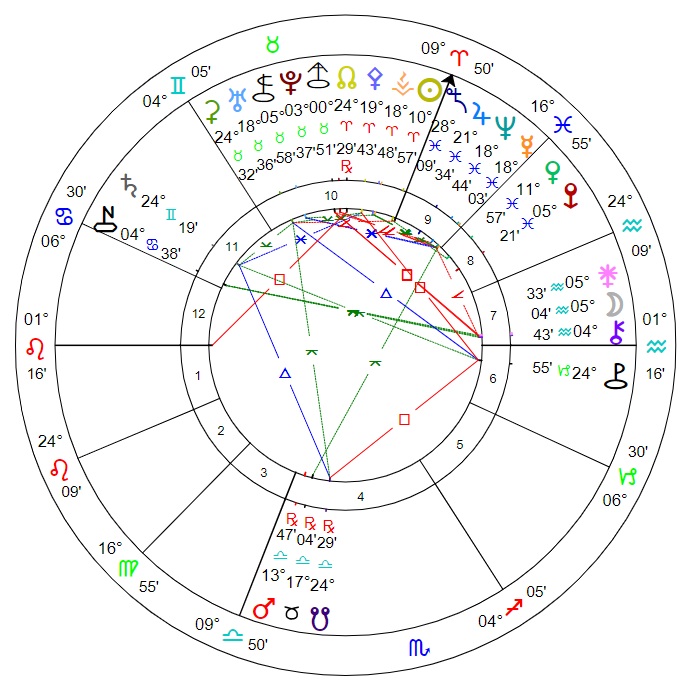 |
| Noon discovery chart for (40) Harmonia: 31st March 1856, Paris, France. |