
Basics
Class: C-type asteroid
Location: Outer main belt, Cybele group
Orbit length (approx): 6.27 years
Discovered: 18th April 1911, 22:09 UTC, from Heidelberg, Germany by Joseph Helffrich
Notes: Large asteroid with mean radius about 52.76 km.
Events at time of discovery:
- April 13 – Birth of Donald Leslie, American creator of the Leslie speaker
- April 17 – The first public performance of “Alexander’s Ragtime Band” was given at the American Music Hall in Chicago.
- April 18 – SS Lusitania, a 5,557-ton Portuguese passenger liner en route from Mozambique to Lisbon, strikes Bellows Rock just off Cape Point and sinks.
- – In response to a demand by U.S. President Taft, and the implied threat of an American invasion, Mexico’s President Diaz informed Ambassador Wilson that his troops would avoid clashes with rebels near the border shared by the two nations. The agreement followed the deaths of two Americans in Douglas, Arizona, from fighting in Agua Prieta. Two days later, Diaz’s formal note claimed that Americans had aided the rebels and had allowed shots to be fired from the U.S. side of the border.
- – Birth of Maurice Goldhaber, Austrian-American physicist
Naming information
Name origin: The genus Luscinia, which contains the common nightingale and three other living species. These are migratory birds originating from Europe and Asia, occurring at various latitudes but more prevalent in temperate regions. The common nightingale is renowned for its powerful and beautiful song.
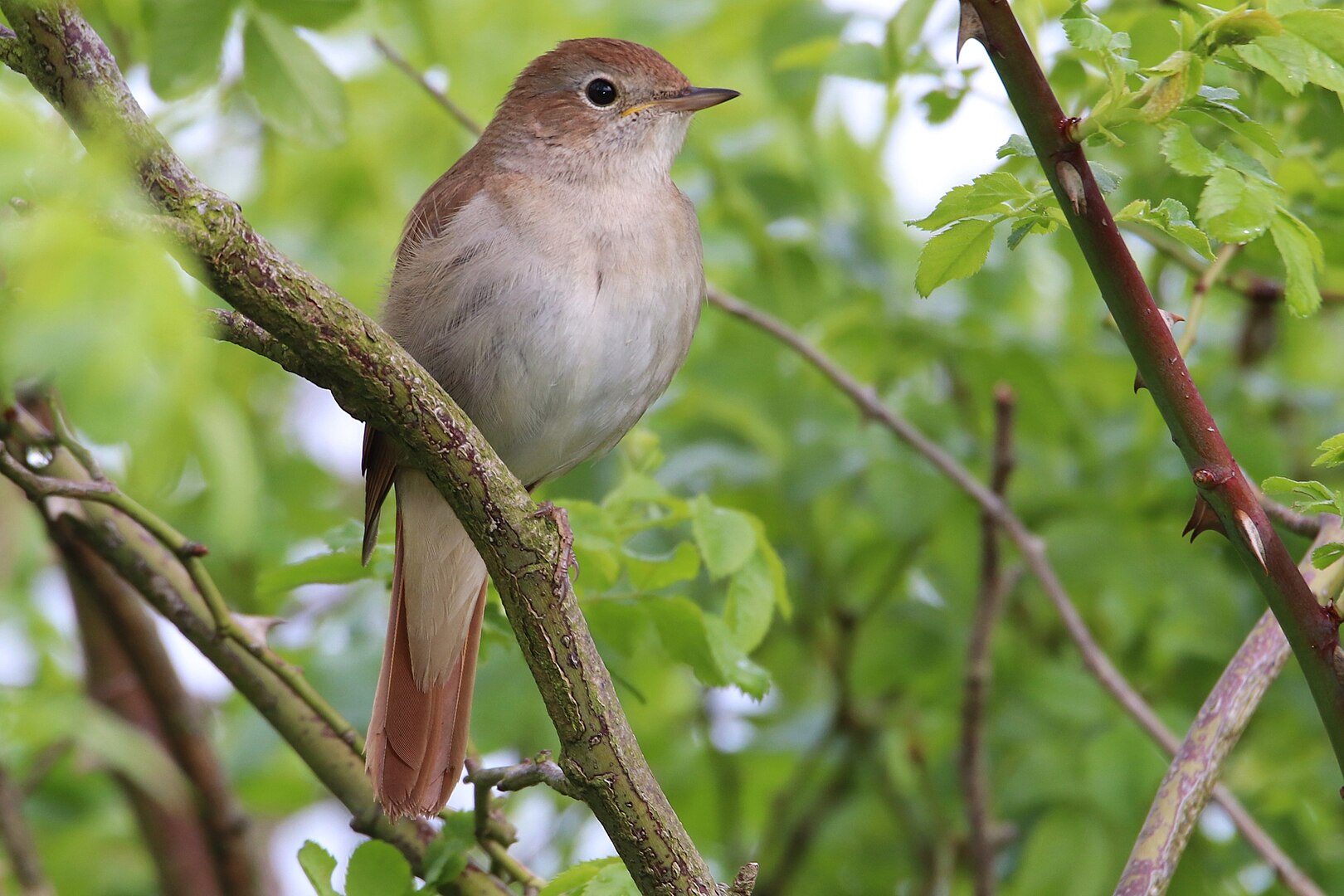 |
| A common nightingale (Luscinia megarhynchos), photographed in Belgium in 2019, by Warrieboy. |
Astrological data
Discovery degree: 15+ Libra
Discovery Sabian: After a Storm a Boat Landing Stands in Need of Reconstruction
Discovery nodal signature: Scorpio–Taurus
Estimated orbital resonances: Earth 3:19, Ceres 8:11, Jupiter 15:8, Saturn 14:3
Discovery chart details: Disseminating phase with T-square between Moon, Pluto and Eris and Finger of the World between Jupiter, Pluto and Eris. Chariklo and Pallas-Sedna on IC. Moon sextile Mars and semi-square Jupiter. Pallas semi-sextile North Node. Venus conjunct Vesta; Mars trine Pluto, sesquiquadrate Juno, semi-square Sedna and semi-sextile Eris. Pallas-Sedna quincunx Jupiter; Uranus sextile Nessus. Chiron semi-sextile Chariklo and opposite Asbolus.
Summary
Possibly implies the richness and potency of sound, and music in particular; the primal strength of deep emotion, which feeds vividness and vitality; the inspiration and beauty of romantic stories and art.
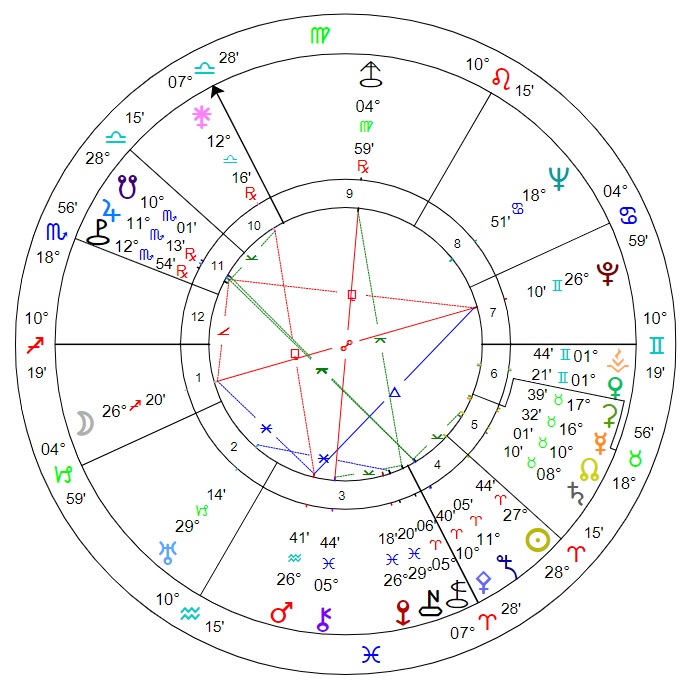 |
| Discovery chart for (713) Luscinia: 18th April 1911, 22:09 UTC, Heidelberg, Germany. The asteroid is not depicted. |