
Basics
Class: S-type asteroid
Location: Outer main belt
Orbit length (approx): 4.82 years
Discovered: 23rd January 1908, 19:39 UTC, from Heidelberg, Germany, by August Kopff
Notes: Mean radius approx. 11.5 km.
Events at time of discovery:
- January 22 – Birth of Lev Landau, Russian physicist, Nobel Prize laureate
- January 24 – Robert Baden-Powell’s Scouting for Boys begins publication in London.
- January 26 – Birth of Stéphane Grappelli, French jazz violinist and composer
Naming information
Name origin: Titan goddess of falling stars, dream divination and astrology.
Mythology: Asteria was the mother of Hekate, goddess of witchcraft and magic, by Perses. After the fall of the Titans, Zeus (being Zeus) chased Asteria across the sky but she escaped him by transforming herself into a quail and then leaping into the sea to become the wandering island of Delos, in which form she later gave shelter to her sister Leto, allowing her to give birth. Apollo later fixed the island in place, making it sacred to him. She may have commonalities with Brizo, a Delian goddess who delivered prophetic dreams.
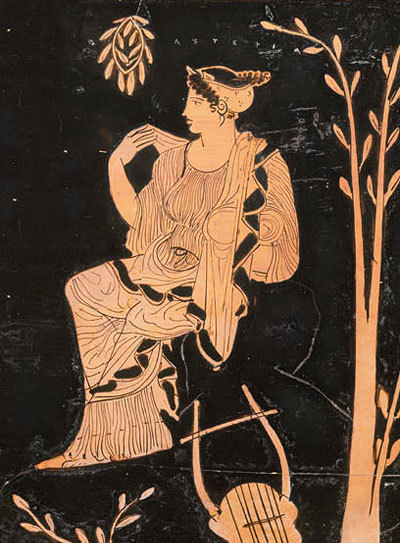 |
| Attic red figure amphora depicting Asteria with a lyre and laurel wreath, attributed to the Kadmos Painter, c.400 BCE. |
Astrological data
Discovery degree: 24+ Cancer
Discovery Sabian: A Will-Full Man is Overshadowed by a Descent of Superior Power
Discovery nodal signature: Pisces–Libra
Estimated orbital resonances: Mercury 1:20, Mars 4:9, Ceres 18:19
Discovery chart details: Disseminating phase chart. Asteria was trine Eris and square Pholus. Moon-Pallas semi-sextile Asbolus; Sun semi-square Chariklo. Uranus opposite North Node. Mercury sextile Mars, opposite Jupiter, semi-square Saturn-Nessus-Eris, sesquiquadrate Pluto and sextile Sedna. Mars trine Jupiter, conjunct Sedna and square Vesta; Jupiter sesquiquadrate Saturn-Eris; Saturn-Nessus square Pluto.
Summary and references
Interpretations offered so far include mainly themes linked to Asteria’s mythology[1]; I’d perhaps add the healing power of acceptance, play and finding joy in the moment, and/or independent, unique self-expression in the context of long-established conventions.
References:
1) TAKE Astrology: Asteroids in Astrology
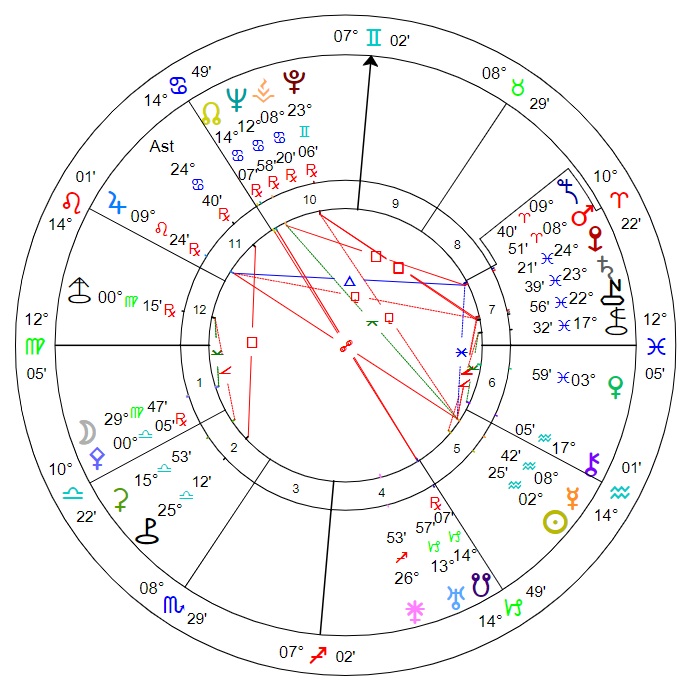 |
| Discovery chart for (658) Asteria: 23rd January 1908, 19:39 UTC, Heidelberg, Germany. |