
Basics
Class: S-type asteroid
Location: Main belt
Orbit length (approx): 4.87 years
Discovered: 28th October 1854 (time unknown) from Paris, France, by Jean Chacornac.
Notes: Eccentricity is 0.338, one of the highest for a lower-numbered minor planet.
Events at time of discovery:
- October 28 – Birth of Mary G. Charlton Edholm, American social purity and temperance reformer
- November – Florence Nightingale and her team of 38 trained volunteer nurses arrive at Selimiye Barracks in Scutari, to care for British troops invalided from the Crimean War.
- November 17 – In Egypt, the Suez Canal Company is formed.
Naming information
Name origin: Greek; one of the nine Muses.
Mythology: Muse of sacred poetry, sacred hymn, dance, eloquence, rhetoric, agriculture and pantomime. Her name comes from the Greek words “poly” meaning “many” and “hymnos”, which means “praise”. She is often portrayed in a pensive or meditative pose, with a solemn expression.
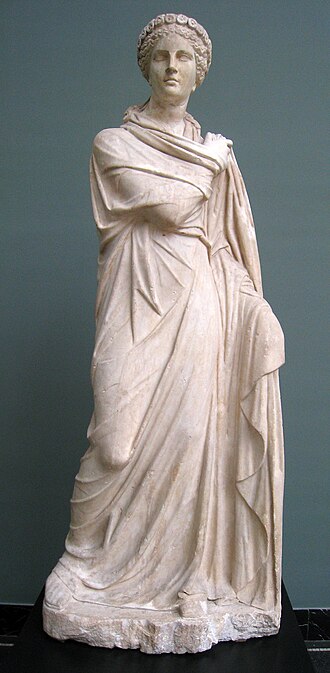 |
| Marble statue of Polyhymnia from Monte Calvo, Italy, 2nd century CE, from the collection of the Ny Carlsberg Glyptotek. Item number IN 1547. Photo by ChrisO. |
Astrological data
Discovery degree: 11+ Taurus
Discovery Sabian: A Young Couple Window-Shopping
Discovery nodal signature: Pisces–Libra
Estimated orbital resonances: Mars 7:16, Ceres 15:16, Jupiter 17:7, Saturn 6:1
Discovery chart details: Noon. Polyhymnia was semi-square Sedna. Mars square Neptune; Pallas conjunct Jupiter; Saturn closely semi-sextile Uranus, sesquiquadrate Juno and semi-square Chariklo. Vesta quincunx Saturn and opposite Uranus; Pluto sextile Eris; Juno opposite Chariklo. Sun may have been within orb trine Nessus.
Summary and references
Key themes may include religious rituals, praise, beliefs and practices[1]; talent in singing, dance, mime, and rhetoric[2]; religious or moral motivation, inspired or driven activity leading to substantive change.
References:
1) Mark Andrew Holmes: Polyhymnia
2) James R. Lewis: The Astrology Book: The Encyclopedia of Heavenly Influences (Visible Ink Press, 2003)
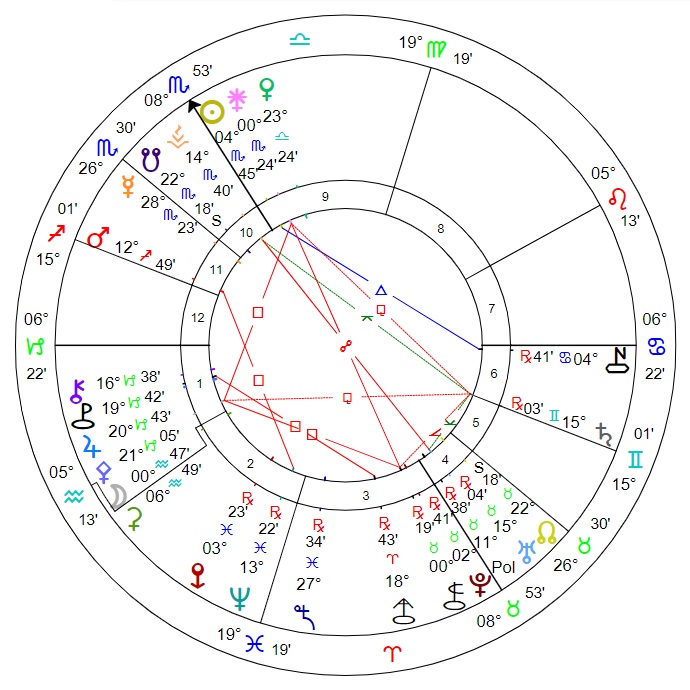 |
| Noon discovery chart for (33) Polyhymnia: 28th October 1854, Paris, France. |