
Basics
Class: Ch-type asteroid
Location: Main belt
Orbit length (approx): 4.25 years
Discovered: 15th March 1863 (time unknown), from Düsseldorf, Germany, by Robert Luther
Notes: Large, dark asteroid with mean radius of approx 123.63 km.
Events at time of discovery:
- February 26 – Abraham Lincoln signs the National Banking Act into law.
- March 3 – The U.S. National Conscription Act is signed, leading to the New York City draft riots in July.
- March 9 – Birth of Emelie Tracy Y. Swett, American author
- March 14 – Queen Victoria issues Letters Patent granting Goulburn city status, making it Australia’s first inland city.
- March 19 – The SS Georgiana is destroyed on her maiden voyage while attempting to run the blockade into Charleston, SC.
Naming information
Name origin: Roman lunar goddess of hunting, counterpart to Artemis.
Mythology: Initially revered as a huntress and patron of hunters, Diana later became associated with farms and the cultivated countryside, or where civilisation meets the wilderness. Like Hekate, she had dominion over roadways, particularly three-way crossroads, thereby giving her an underworld aspect. She also oversaw fertility, childbirth, the moon and celestial realms.
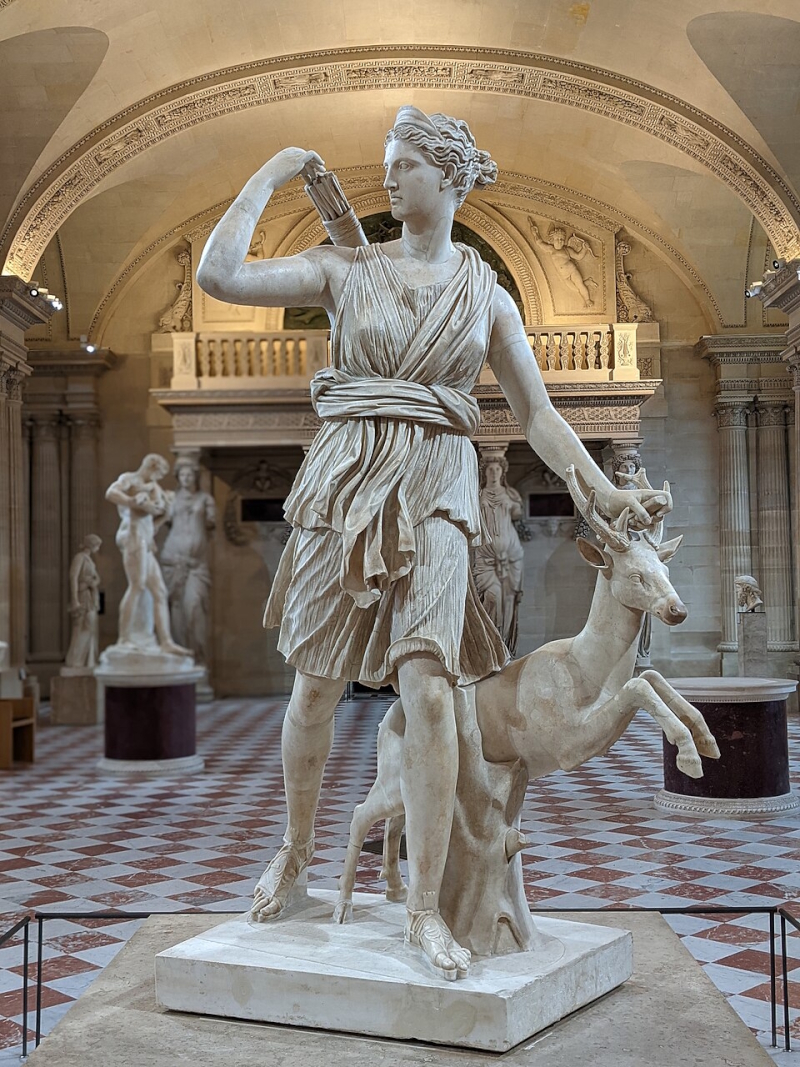 |
| Diana of Versailles, a 2nd-century Roman marble statue in the Greek tradition of iconography, held at the Louvre Museum, Paris, France. |
Astrological data
Discovery degree: 3+ Libra
Discovery Sabian: Around a Campfire a Group of Young People Sit in Spiritual Communion
Discovery nodal signature: Pisces–Leo
Estimated orbital resonances: Earth 4:17, Mars 1:2, Ceres 12:11, Jupiter 14:5, Chiron 12:1
Discovery chart details: Noon chart. Diana was conjunct Saturn; both formed a kite with Mars-Asbolus, Pholus and Neptune. Jupiter was semi-square, Pluto quincunx, Pallas semi-sextile and Chariklo opposite the North Node. Venus was sextile Uranus and opposite Juno; Mars-Asbolus sesquiquadrate Ceres. Juno was trine Uranus and Vesta semi-square Pluto.
Summary and references
Interpretations given so far include: quiet movement, self-protection, instinctive response to inappropriate behaviour[1]; the feminine hunter/warrior, wild and untamable power, strengths, independence of social constraint, fighting for one’s rights[2]; attunement to animals and nature, feeling chased, elusiveness[3]; love of animals, protection of children and of women in childbirth[4]; the unmarried mother figure, isolation, self-containment[5]; the principle of survival and protection, inviolability, vitality and aspirations of young womanhood, instinctive understanding of nature and its laws, privacy and self-identification, protectiveness towards those in need[6]; sense of divine right and consequent intolerance[7]; hunter-prey, conquest-related and animalistic behaviours and attitudes[8].
References:
1) Amable: (78) Diana
2) Neptune’s Aura Astrology: Asteroids Diana 78 and Artemis 105
3) Martha Lang-Wescott: Basic Resources
4) TAKE Astrology: Asteroids in Astrology
5) Zipporah Dobyns: Expanding Astrology’s Universe (ACS Publications, Inc., 1983)
6) Demetra George & Douglas Bloch: Asteroid Goddesses (Ibis Press, 2003)
7) J. Lee Lehman: The Ultimate Asteroid Book (Whitford Press, 1988)
8) Jacob Schwartz: Asteroid Name Encyclopedia (Llewellyn Publications, 1995)
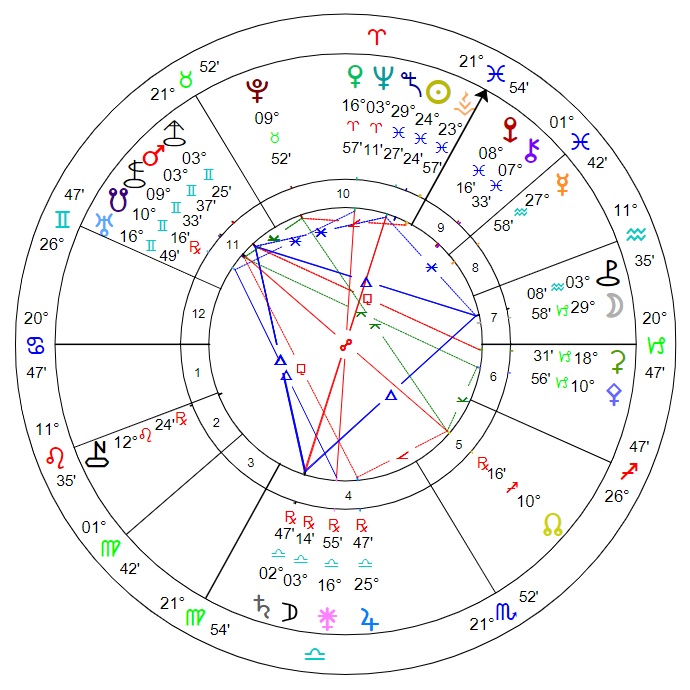 |
| Noon discovery chart for (78) Diana: 15th March 1863, Düsseldorf, Germany. |